
There’s a specific kind of stress that comes with being sick, or needing a prescription refilled, or noticing something concerning on your skin – and realizing you don’t actually have a family doctor to call. You’re not being irresponsible. You’re one of an estimated 2.5 million Ontarians currently without a regular family physician, a number that’s grown steadily as the province’s primary care shortage has deepened.
If you’ve searched “walk-in clinic no family doctor Etobicoke” or “what to do if you don’t have a family doctor,” you’re already doing the right thing – looking for a practical bridge instead of just waiting it out. This guide covers exactly how to use walk-in care effectively while you’re unattached, what its real limits are, and how to move from “no doctor at all” to “doctor I actually see regularly.”
The Problem: Being “Unattached” in a System Built Around Continuity
Ontario’s health system, on paper, assumes most people have a family doctor. Referrals, chronic disease monitoring, prescription renewals, preventive screenings – a huge amount of it is designed around an ongoing relationship with one physician who knows your history.
When you don’t have that, you’re what the system calls an “unattached patient,” and it changes how you experience healthcare. Every visit starts from zero. You explain your medical history again. You may see a different physician each time. Prescriptions that used to be a five-minute renewal become a fresh walk-in visit. And chronic issues — a slowly rising blood pressure, a family history of diabetes you’ve never been screened for — can go unmonitored simply because there’s no one tracking the pattern over time.
This is the reality behind the search: people aren’t asking “what is a walk-in clinic” — they already know. They’re asking whether walk-in care is actually enough, and what they should be doing in parallel to fix the underlying problem.
The Discovery: Walk-In Care Is a Bridge, Not a Replacement
Here’s the honest answer: walk-in clinics are genuinely good at what they’re built for — acute, immediate concerns. A cold that’s turned into a sinus infection. A sprained ankle. A UTI. A same-day prescription for something that just started. For these situations, a walk-in visit is often faster and just as effective as a family doctor appointment would be.
Where walk-in care falls short is anything that depends on pattern recognition over time: catching that your resting heart rate has crept up over three years, noticing a slow decline in kidney function through repeated bloodwork, or connecting a new symptom to a family history you mentioned at a completely different clinic eighteen months ago. A walk-in physician, however competent, is meeting you fresh every visit.
The smartest approach for unattached Etobicoke residents isn’t choosing one over the other — it’s using walk-in care as your safety net for anything urgent, while actively working the second track: getting rostered with a family doctor.
The Opportunity: How to Use a Walk-In Clinic the Right Way
Not all walk-in visits are created equal. A few habits make a real difference in the quality of care you get as an unattached patient:
Bring a running list, even without a chart. Since the clinic doesn’t have your history on file, you’re effectively the keeper of your own record. Keep a simple note on your phone: current medications, known allergies, major past diagnoses, family history of note. Handing this to a walk-in physician instantly closes most of the “starting from zero” gap.
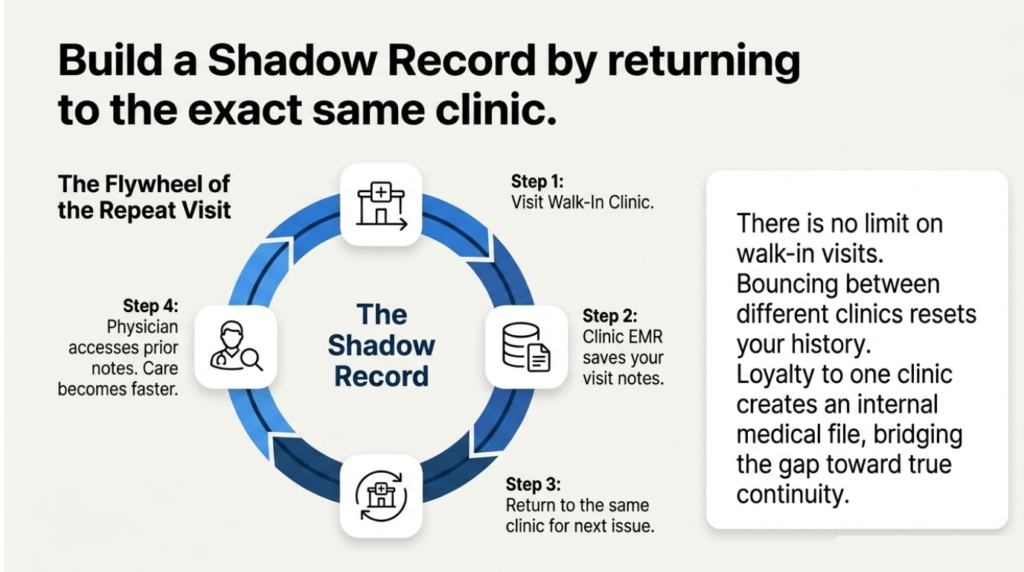
Return to the same clinic when possible. Many walk-in clinics, including ones with multiple physicians on staff, keep an internal record of your visits even without you being formally “rostered.” Going back to the same location repeatedly means the second and third visits are noticeably faster and more informed than the first.
Ask directly about family doctor availability at that clinic. This is the single most overlooked move. Many patients treat walk-in visits and family doctor searches as two separate errands, when in reality, some walk-in clinics also have family physicians building their rosters. Asking “is anyone here taking new patients?” during a walk-in visit costs nothing and occasionally gets you attached faster than any external waitlist.
Don’t wait for a “big enough” reason to go. A common and costly habit among unattached patients is saving up minor concerns until they feel serious enough to justify a visit. This often means preventable issues — a mild but persistent cough, early signs of a skin infection — become bigger problems by the time they’re addressed.
Same-Day Care vs. the Emergency Room
One of the most consequential decisions unattached patients face is whether a symptom warrants a walk-in clinic or an ER visit. As a general guideline: walk-in clinics handle non-emergency issues — infections, minor injuries, prescription renewals, cold and flu symptoms, skin concerns — usually within the same day and without the multi-hour wait typical of an emergency department.
Emergency rooms exist for what their name implies: chest pain, difficulty breathing, severe injury, signs of stroke, or anything that could deteriorate quickly. Using the ER for a walk-in-level concern doesn’t just mean a longer wait for you — it also strains a system already under significant pressure. When in doubt about severity, a phone call to Telehealth Ontario (811) or the walk-in clinic itself can help you determine the right level of care before you go.
Getting Rostered While You’re Still Using Walk-In Care
Being unattached doesn’t have to be permanent, and it shouldn’t be treated as a waiting game with no active steps. A few concrete moves:
Register with Health Care Connect. It’s Ontario’s official matching service for unattached patients, and while wait times vary, registering costs nothing and starts the clock.
Call clinics directly, not just the province-wide waitlist. Individual clinics often open rostering spots that never make it onto a centralized list, simply because a physician’s roster just had capacity open up. This is where persistence pays off — a clinic that said “not currently” three months ago may be accepting patients now.
Consider a clinic that offers both walk-in and family medicine under one roof. This is a meaningfully different experience than bouncing between unrelated walk-in locations. At a combined practice, your walk-in visits are at least recorded within the same clinic system, and if a family doctor’s roster opens, you may already have a file and a track record there.
A Practical Next Step
If you’re currently unattached in Etobicoke, here’s the realistic two-track plan: use walk-in care without guilt or hesitation for anything that needs attention now, and simultaneously call a local clinic — ideally one with both walk-in service and family physicians on staff — to ask directly about current rostering availability.
Marklandwood Medical Clinic, at 4335 Bloor Street West, offers exactly this combination: same-day walk-in care for anyone who needs it, alongside a roster of family physicians whose availability shifts throughout the year. Rather than treating your walk-in visits and your family doctor search as two disconnected efforts, calling (416) 695-8878 lets you handle both in the same conversation — get seen today, and ask what it would take to be added to a doctor’s list going forward.
Frequently Asked Questions
What should I do if I don’t have a family doctor in Ontario? Register with Health Care Connect, Ontario’s official matching service, and in parallel, call local clinics directly to ask about current rostering availability, since some openings never appear on the centralized waitlist. Use walk-in clinics for anything urgent in the meantime.
Can I go to a walk-in clinic if I’ve never been there before? Yes. Walk-in clinics don’t require you to be an existing patient or have a referral — you can simply arrive during their open hours and be seen by whichever physician is on duty.
How many times can I visit the same walk-in clinic? There’s no limit. In fact, returning to the same walk-in clinic repeatedly is a smart strategy for unattached patients, since some clinics keep an internal record of your prior visits even without formal rostering.
Is walk-in care as good as having a family doctor? For acute, one-off concerns, walk-in care is generally just as effective. Its main limitation is continuity — a walk-in physician doesn’t track your health patterns over months or years the way a family doctor does, which matters most for chronic disease management and preventive screening.
What’s the difference between a walk-in clinic and an urgent care centre? In most of Ontario, “walk-in clinic” and “urgent care” are used somewhat interchangeably for non-emergency same-day care, though some urgent care centres are equipped to handle slightly more complex injuries. Neither replaces an emergency room for serious or life-threatening symptoms.
Can a walk-in clinic prescribe medication? Yes. Walk-in physicians can prescribe and renew most medications during your visit, though certain controlled substances may require additional documentation or a discussion with your regular prescriber if you have one.
Do walk-in clinics keep a record of my visit for next time? Many do, particularly clinics that are part of a larger practice with electronic medical records. This is one reason returning to the same clinic repeatedly, rather than visiting a different one each time, can improve continuity even without a formal family doctor.
How long is the average wait at a walk-in clinic in Etobicoke? Wait times vary by time of day and clinic volume, with early mornings and weekday evenings often busier. Calling ahead or checking whether the clinic posts current wait times can help you time your visit.
Should I go to a walk-in clinic or the emergency room for chest pain? Chest pain, especially with shortness of breath, sweating, or pain radiating to the arm or jaw, warrants an emergency room visit or calling 911, not a walk-in clinic. Walk-in care is appropriate for non-emergency concerns.
Can I get bloodwork or lab requisitions from a walk-in clinic? Yes, walk-in physicians can order bloodwork, imaging, and other lab tests the same as a family doctor would, based on your symptoms and history at that visit.
What is Health Care Connect and how do I register? Health Care Connect is Ontario’s free service that matches unattached patients with a family doctor or nurse practitioner accepting new patients. You can register online or by phone, though wait times for a match vary by region.
Can walk-in clinics refer me to a specialist? Yes. A walk-in physician can write a specialist referral just as a family doctor can, based on the concern you present at that visit.
Is it bad to rely on walk-in clinics long-term instead of a family doctor? It’s not inherently harmful for acute issues, but it does create gaps in chronic disease monitoring and preventive care that a family doctor relationship is specifically designed to catch. It’s worth actively pursuing a family doctor even while relying on walk-in care in the meantime.
Do I need an appointment for a walk-in clinic, or can I just show up? No appointment is needed — that’s the defining feature of walk-in care. Some clinics do offer optional online check-in or call-ahead options to reduce your wait once you arrive.
Can children and seniors use walk-in clinics the same way as adults? Yes, walk-in clinics see patients of all ages for non-emergency concerns, though for infants, complex senior care, or anyone with multiple chronic conditions, an established family doctor relationship becomes increasingly valuable over time.
What should I bring to a walk-in clinic if I don’t have a health record? Bring your OHIP card, a list of current medications and allergies, and a brief written summary of relevant medical history. Since the clinic won’t have your full chart, this information helps the physician treat you more accurately in a single visit.