
High cholesterol is one of the most significant, yet modifiable, risks for cardiovascular disease. A laboratory report may provide a range of values, including total, LDL and HDL cholesterol, non-HDL cholesterol and triglycerides. Interpreting what these numbers mean helps put the conversation with a physician in perspective.
High cholesterol typically does not cause symptoms. A person can be unaware of high cholesterol as it progressively accumulates in the arteries as fatty plaque, eventually leading to atherosclerosis. This condition ultimately increases the risks of developing coronary artery disease, heart attack and stroke. A blood test, then, is appropriate to identify unhealthy lipid levels and guide treatment.
For residents of Etobicoke, speaking with a family physician in Etobicoke about test results serves as a practical way to put personal results in context. In Canada, assessing cardiovascular risk takes priority over simply categorizing one’s cholesterol as normal versus abnormal. The focus is on a person’s overall risk for heart disease, and this is determined by a range of factors in addition to lipid levels: age, blood pressure, diabetes, kidney function, genetic predisposition and history of heart disease.
Key Notes: Understanding Cholesterol at a Glance
LDL cholesterol (LDL-C): “Bad” cholesterol; desirable levels are lower
HDL cholesterol (HDL-C): “Good” cholesterol; desirable levels are higher
Total cholesterol: Sum of all cholesterol particles; it is not typically used as a stand-alone measure
Non-HDL: Total cholesterol minus HDL cholesterol; a desirable level is lower
Triglycerides: Another type of blood fat in addition to cholesterol that contribute to heart disease risk
Interpretation of cholesterol test results should be based on overall cardiovascular risk rather than a single value
Lipid screening is recommended in Canada for people over the age of 40, and for younger adults with additional cardiovascular risk factors
What Do the Different Cholesterol Numbers Mean?
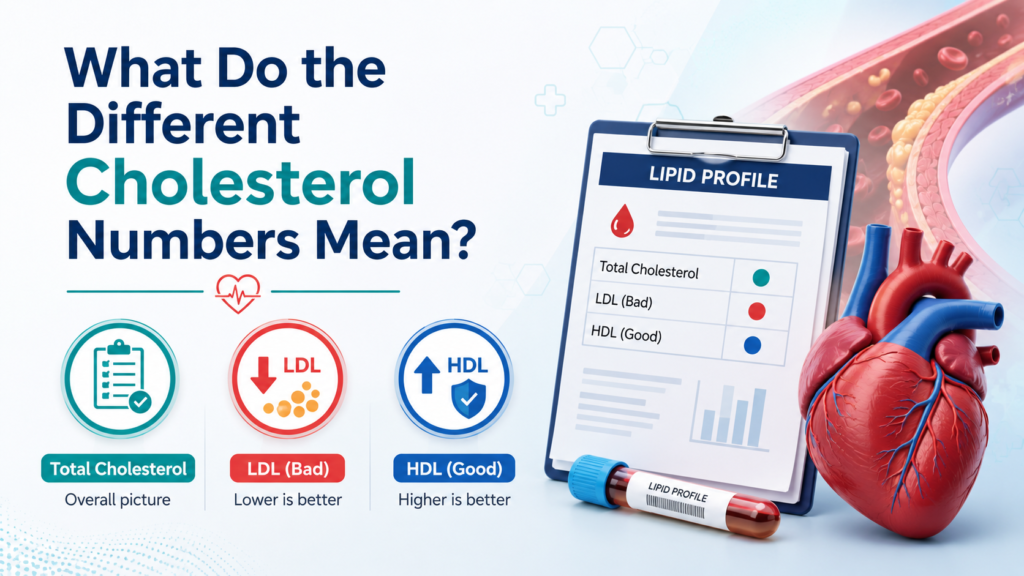
Understanding Total Cholesterol
The “total cholesterol” represents the overall cholesterol in the blood. This value is calculated by summing all cholesterol particles, including those associated with LDL, HDL and other lipoproteins. Although patients often fixate on this value, as it may stand out on a laboratory report, clinicians typically pay closer attention to individual components of the lipid profile. For example, two people may have similar total cholesterol, but one may have higher-than-average LDL and lower-than-average HDL, compared to the other.
When it comes to total cholesterol, a “higher is better” approach is not appropriate, as it is not a stand-alone measure. Canadian physicians focus on individual risk factors, including non-HDL cholesterol, triglycerides, blood pressure, diabetes, age, cigarette smoking and other variables when assessing cardiovascular risk. For many people without existing heart disease, calculating overall risk with a tool such as the Framingham Risk Score also plays a role in treatment decision-making.
Understanding LDL Cholesterol (LDL-C)
Low-density lipoprotein cholesterol or LDL-C is often referred to as “bad” cholesterol. The name stems from the observation that high levels of this fat in the blood promote the development of atherosclerosis. Specifically, LDL particles carry cholesterol to the arteries, where it can accumulate as plaque. Therefore, lowering LDL is an important treatment goal in patients with atherosclerosis.
In general, lower LDL-C is desirable, particularly for patients with high cardiovascular risk. However, there is not a single desirable or abnormal value that applies to every Canadian adult. Canadian Cardiovascular Society guidelines suggest that physicians consider the overall cardiovascular risk, existing conditions and specific patient factors when deciding whether treatment is warranted. For example, in patients with no history of heart disease, an LDL-C level of 5.0 mmol/L or higher is generally considered high enough to warrant treatment with cholesterol-lowering drugs called statins, regardless of other variables. By contrast, an LDL-C level of 3.5 mmol/L or higher in a patient with multiple risk factors may also prompt a physician to recommend statins.
It is important to remember that these are general guidelines and that the decision to treat should always be made on an individual basis. These values indicate when treatment may be appropriate, but a statin prescription should never be self-administered.
Understanding HDL Cholesterol (HDL-C)
High-density lipoprotein cholesterol or HDL-C is often referred to as “good” cholesterol, since higher levels are generally associated with lower cardiovascular risk. Similar to LDL, HDL carries cholesterol through the body. However, contrary to LDL, HDL decreases the risks of developing atherosclerosis and coronary artery disease. According to Heart & Stroke Canada, an ideal HDL-C level is anything higher than 1.0 mmol/L in men and 1.3 mmol/L in women.
Nevertheless, patients should not consider their HDL level in isolation, since an apparently favorable HDL-C does not offset other significant risks, such as high LDL-C, age, smoking and diabetes. It is for this reason that a physician evaluates an entire lipid profile rather than a single value when assessing heart disease risk.
Although higher HDL-C levels are desirable, exercise and other lifestyle modifications are also effective ways of increasing this value. As recommended by Heart & Stroke, an average adult should aim for approximately 150 minutes of moderate-to-vigorous physical activity per week for better cardiovascular health.
What Are Non-HDL Cholesterol and Triglycerides?
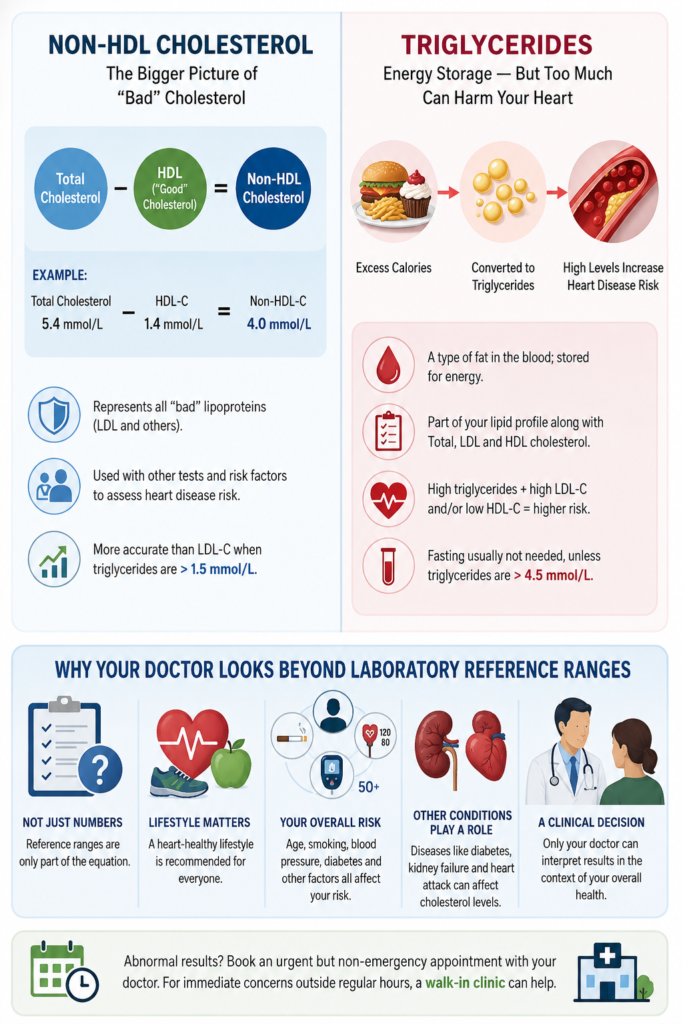
Understanding Non-HDL Cholesterol
Non-HDL cholesterol is calculated as the difference between total cholesterol and HDL cholesterol. The resulting value essentially represents all cholesterol carried by “bad” lipoproteins, including LDL and others. Similar to total cholesterol, non-HDL is not used in isolation, since it fails to consider additional crucial variables, including triglycerides.
For example, if a person’s total cholesterol is 5.4 mmol/L and HDL-C is 1.4 mmol/L, his non-HDL cholesterol is 4.0 mmol/L (5.4 total minus 1.4 good cholesterol). This value is then combined with other tests and risk factors to estimate cardiovascular risk. Nonetheless, a person should not be overly concerned about non-HDL levels, since they serve primarily as an additional indicator of heart disease risk.
The Canadian Cardiovascular Society notes that, in people with triglyceride levels higher than 1.5 mmol/L, non-HDL cholesterol or apolipoprotein B may be more accurate measures of cardiovascular risk compared to LDL-C. This is because calculated LDL-C becomes less reliable in patients with abnormally high triglycerides.
Understanding Triglycerides
Triglycerides are fats in the blood, and they are essentially another type of cholesterol. Unlike LDL and HDL, triglycerides are not used for constructing cell membranes. Instead, they are a storage form of energy. The body actively converts excess calories into triglycerides, which can then be burned for energy when needed. Nevertheless, abnormally high levels of this substance contribute to heart disease risk.
A lipid profile typically includes a test for triglycerides, along with total, LDL and HDL cholesterol. According to Heart & Stroke, high triglycerides in combination with high LDL-C and/or low HDL-C substantially increase cardiovascular risk. Extremely high levels of triglycerides may also be dangerous and require separate treatment. Fortunately, most people do not need to fast before a routine cholesterol test.
The Canadian Cardiovascular Society notes that fasting is generally unnecessary for a lipid profile, unless triglyceride levels are expected to be very high (greater than 4.5 mmol/L).
Why Your Doctor Looks Beyond Laboratory Reference Ranges
When reviewing test results, patients often wonder if high cholesterol means they need to talk to a doctor sooner rather than later. At the same time, normal levels frequently raise questions about other potential problems. The truth is that neither exceptionally high nor normal values necessarily dictate the need for immediate action, since reference ranges are only part of the equation.
A heart-healthy lifestyle is recommended for everyone, regardless of test results. Furthermore, a single abnormal laboratory value rarely dictates the sole course of action, since diseases such as diabetes, kidney failure and heart attack also affect cholesterol levels. In addition, a doctor considers a patient’s overall cardiovascular risk, which is influenced by factors such as age, smoking and blood pressure when deciding whether additional testing or treatment is required.
It is important to mention, however, that interpretation of laboratory values is ultimately a clinical decision that only a doctor can make. A lipid profile is informative, but it should always be reviewed in the context of a person’s overall health. Patients with abnormal results may wish to schedule an urgent but non-emergency consultation with a physician. In the meantime, a walk-in clinic in Etobicoke can help address immediate concerns outside regular office hours.
Why High Cholesterol Happens and Who Should Be Tested
There are several reasons why a person may have high cholesterol. In particular, genetics plays a significant role in determining overall cholesterol and LDL-C levels, specifically. Nevertheless, diet, exercise, body weight, diabetes, cigarette smoking and other factors also contribute. Saturated fat, in particular, raises LDL-C levels and should be limited in the heart-healthy diet.
Familial hypercholesterolemia is a genetic condition associated with extremely high LDL-C levels from a young age. This tends to contribute to significantly increased cardiovascular risk and is associated with heart attacks at a young age. Canadian cholesterol guidelines recognize familial hypercholesterolemia as a condition that requires treatment with statins.
Patients with close relatives who have had heart disease or abnormally high cholesterol at a young age should inform their doctors. Heart & Stroke recommends discussing the appropriateness of genetic screening for familial hypercholesterolemia during such consultations.
Understanding High Cholesterol Testing Guidelines
According to Canadian cholesterol guidelines, everyone over the age of 40 should undergo routine testing for high cholesterol. A physician may also recommend a blood test for younger adults if they have additional risk factors for developing heart disease. Lifestyle modifications, including a heart-healthy diet and regular physical activity, often help decrease LDL-C levels if a person has high cholesterol.
Nonetheless, test results are not the only consideration in deciding whether treatment is needed. For instance, a doctor will evaluate other aspects of a patient’s cardiovascular health, including body weight, blood pressure, the presence of risk factors such as diabetes and smoking, and overall risk for developing heart disease. This risk assessment can be used to estimate future cardiovascular events, including heart attack and stroke.
A routine discussion with a family physician in Etobicoke is particularly important for people at high risk for developing heart disease or those already receiving cholesterol-lowering treatment. This is because a physician can weigh different considerations, including test results, in context and estimate how often follow-up testing is needed. In some cases, the doctor may also want to review other aspects of a patient’s health, including general well-being and body weight.
How High Cholesterol Is Managed
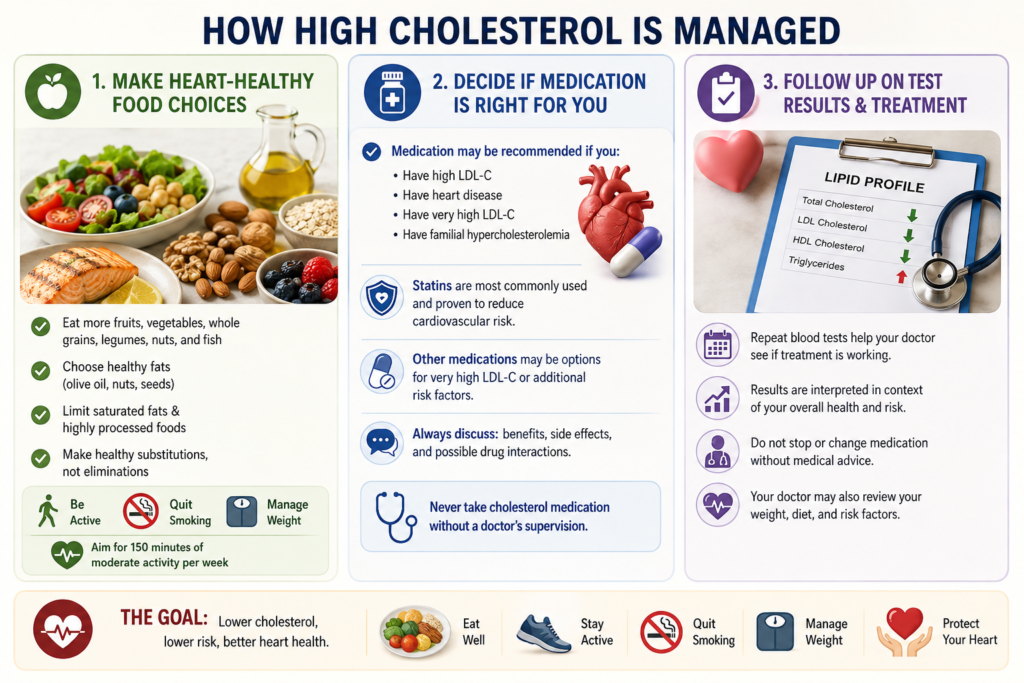
Making Heart-Healthy Food Choices
A heart-healthy diet is an essential component of high cholesterol management. In general, it is advisable to restrict highly processed foods and emphasize fruits, vegetables, whole grains, legumes, nuts, seeds, fish, lean cuts of meat and low-fat dairy products. Choosing foods with unsaturated fats is also important for lowering LDL-C. For instance, olive oil can be used instead of butter or lard, and foods high in fiber, such as beans and lentils, should be eaten more often.
A heart-healthy diet also means eating more fruits, vegetables and whole grains and restricting highly processed foods. It is important to make healthy substitutions, rather than eliminating entire groups of food. In addition to reducing saturated fat, an ideal heart-healthy eating pattern encourages the consumption of healthy fats, such as polyunsaturated and monounsaturated fats.
Physical activity, smoking cessation counselling and weight management also play a role in lowering cholesterol and reducing cardiovascular risk. Moderate physical activity, such as brisk walking, can lower LDL-C, HDL-C and triglycerides. For best results, Heart & Stroke recommends approximately 150 minutes of moderate-to-vigorous physical activity per week, while smoking cessation is strongly encouraged for people with high cholesterol.
Deciding Whether Medication Is Right for You
Although a heart-healthy diet is an essential component of high cholesterol management, some patients also benefit from medication. In general, drugs to lower cholesterol should be considered in patients with high blood cholesterol, established cardiovascular disease, very high levels of LDL-C, or familial hypercholesterolemia. Statins are the most widely used cholesterol-lowering drugs, and they have been shown to reduce cardiovascular risk in carefully selected patients.
Other cholesterol-lowering medications may be an option for patients with very high LDL-C levels or additional risk factors for developing heart disease. Overall, a physician should be able to recommend a specific drug and estimate how much it will lower a person’s LDL-C based on individual circumstances. Patients should also speak with their doctor about potential side effects and other factors, such as drug interactions.
It is important to note that medication should never be taken without a doctor’s supervision. While a heart-healthy diet can help everyone, including people with normal cholesterol levels, individual requirements for medication also depend on other factors beyond blood cholesterol, such as age, diabetes, kidney function, cardiovascular risk and body weight.
Following Up on Test Results and Treatment
After being diagnosed with high cholesterol, a person may need to return for another blood test to ensure their treatment is working. This may involve repeating the cholesterol blood test at a later date so that the physician can compare results and estimate whether an adjustment to the treatment plan is necessary. A change in test results should always be interpreted in context, taking into account a person’s overall health, diet, treatment and other factors.
A lower than expected cholesterol reading, for instance, is not a reason to stop medication without consulting a doctor. A blood test showing that treatment has been effective can be motivating, while dosage adjustments should also be made in consultation with a doctor. In addition to repeat cholesterol tests, physicians may also want to review other aspects of a patient’s health, such as weight, diet and cardiovascular risk factors.
Conclusion
Understanding cholesterol levels becomes easier when the individual numbers are put in context. LDL cholesterol represents one of the key atherogenic cholesterol fractions, and it is generally desirable to keep it as low as possible. HDL cholesterol is considered “good” cholesterol, and higher levels are generally associated with better cardiovascular health. Non-HDL cholesterol encompasses other atherogenic cholesterol particles in addition to LDL and can be used as an additional risk metric.
At the same time, it is important to recognize that high cholesterol management is not done in isolation. In Canada, physicians emphasize the importance of an individual’s overall cardiovascular risk rather than simply classifying a cholesterol test as normal or abnormal. Other factors, including age, smoking, blood pressure, diabetes, kidney disease, family history and existing heart disease can also affect test results and treatment. Patients who receive abnormal test results can always speak with a doctor to understand their options.
A walk-in clinic in Etobicoke is also a convenient option for those who require immediate but non-emergency medical advice. At the same time, a regular physician can help put cholesterol test results in perspective, as well as review other cardiovascular risk factors, including body weight, blood pressure and diabetes risk.
Frequently Asked Questions About High Cholesterol
1. What cholesterol number is most important?
LDL cholesterol is generally the most important number in a cholesterol blood test, since higher than normal levels are associated with increased cardiovascular risk. Nonetheless, a physician typically takes other values, including non-HDL cholesterol, HDL, triglycerides and overall cardiovascular risk, into account when reviewing test results.
2. Is 3.5 mmol/L LDL cholesterol high?
An LDL-C level of 3.5 mmol/L is generally considered high in Canada, since values of 3.5 mmol/L and higher are associated with increased cardiovascular risk for most patients. According to Canadian cholesterol guidelines, a LDL-C level of 3.5 mmol/L or higher typically warrants treatment with statins, depending on a person’s overall risk.
3. What does an LDL cholesterol of 5.0 mean?
LDL-C level of 5.0 mmol/L or higher is generally considered very high in Canada, since it significantly increases the risk of developing cardiovascular disease. According to Canadian cholesterol guidelines, a level of 5.0 mmol/L typically requires treatment with statins. Additionally, such a result may prompt genetic screening for familial hypercholesterolemia.
4. Is high HDL cholesterol always protective?
Higher levels of HDL cholesterol are generally associated with reduced cardiovascular risk, since this type of cholesterol is considered “good.” Nonetheless, a physician reviews all lipid profile results when assessing heart disease risk, and high HDL levels do not offset other risk factors, including high LDL-C, non-HDL cholesterol, triglycerides, age, smoking, diabetes and existing cardiovascular disease.
5. What is non-HDL cholesterol?
Non-HDL cholesterol represents all cholesterol carried by “bad” lipoproteins, including LDL and other atherogenic cholesterol particles. It is calculated as the difference between total and HDL cholesterol and can be used as an additional tool for estimating cardiovascular risk. According to the Canadian Cardiovascular Society, non-HDL cholesterol is an especially important risk factor in people with very high triglyceride levels.
6. Do I need to fast before a cholesterol test?
Fasting is generally not required for a cholesterol blood test, since recent Canadian guidelines recommend routine lipid screening in both the fasting and non-fasting states. Nonetheless, some patients, such as those with extremely high triglycerides, may be advised to fast before the test.
7. Can high cholesterol cause symptoms?
High cholesterol rarely causes symptoms on its own, which is why a blood test that assesses lipid levels is important. Over time, abnormally high cholesterol contributes to the development of atherosclerosis, which eventually leads to coronary artery disease, heart attack and stroke.
8. Can diet help decrease my LDL cholesterol?
Diet is an essential component of high cholesterol management. In particular, a heart-healthy diet that is low in saturated fat and emphasizes whole foods, fruits, vegetables, legumes, nuts, seeds, whole grains and healthy fats can help decrease LDL-C levels.
9. Can I have high cholesterol even if I am exercising?
Yes, a heart-healthy diet and regular physical activity can reduce cholesterol levels, but they are generally not sufficient on their own. A person continues to have high cholesterol if they have a genetic predisposition, diabetes or other medical conditions, or if they are taking certain medications.
10. How often should I get my cholesterol tested?
The frequency of cholesterol blood tests depends on several factors, including age, cardiovascular risk, treatment and test results. In general, Canadian cholesterol guidelines recommend lipid screening for everyone over the age of 40, and for younger adults with additional cardiovascular risk factors.
Medical Disclaimer: This article is intended for educational purposes only and is not a substitute for professional medical advice. Cholesterol screening and treatment recommendations should be individualized by a physician, taking into account a person’s cardiovascular risk, overall health and other relevant factors. Patients are encouraged to discuss their cholesterol test results and treatment plan with a qualified healthcare professional.