
You wake up with a sore throat that’s been building for two days, or you notice your blood pressure reading at the pharmacy looked a little high, or your child has had a low fever since last night – and the first real question isn’t “what’s wrong,” it’s “who do I actually call for this?”
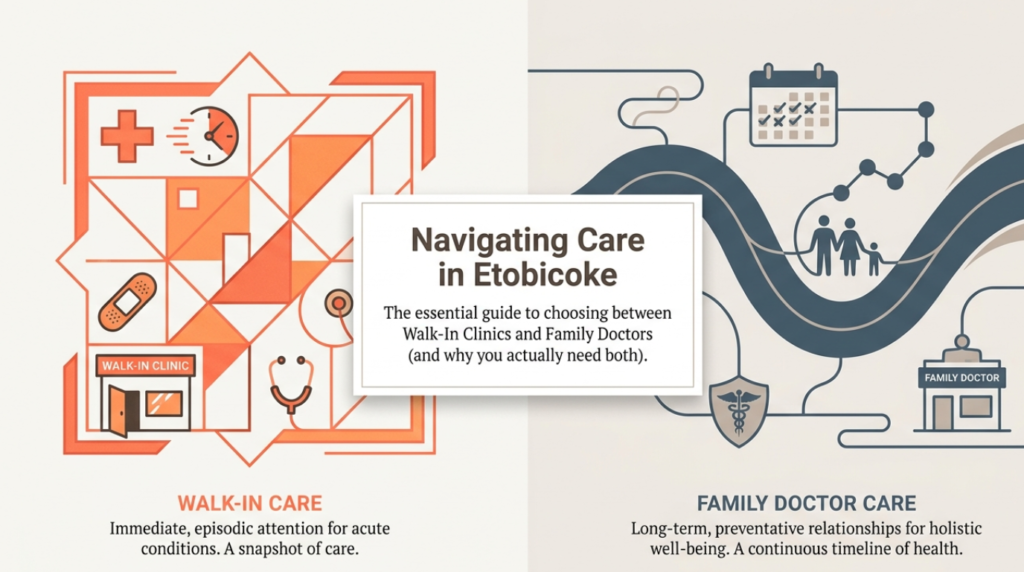
This is one of the most common healthcare decisions Etobicoke residents face, and it’s rarely explained clearly. This guide breaks down exactly when a walk-in clinic is the right call, when a family doctor is the better choice, and why – for most households – the honest answer is that you eventually need both, used for different purposes.
The Problem: Two Options, No Clear Rulebook
Nobody hands you a flowchart when you move to a new neighbourhood explaining which type of care to use when. Most people default to whichever option is fastest to book, which usually means walk-in care – even for things that would genuinely benefit from a doctor who knows their history.
The confusion is understandable. Both walk-in clinics and family doctors are staffed by licensed physicians. Both are covered by OHIP. Both can prescribe medication, order bloodwork, and write referrals. On the surface, they look interchangeable. The real differences only show up over time, and by the time people notice them, it’s often because something was missed.
The Discovery: What Actually Separates the Two
The core difference isn’t the quality of the physician – it’s continuity. A family doctor sees you repeatedly, builds a chart that spans years, and starts to notice patterns: a slowly climbing blood pressure reading, a cholesterol number that’s crept up two years running, a family history that becomes relevant only when a new symptom appears. A walk-in physician, by contrast, is solving today’s problem with today’s information, because that’s structurally all they have access to.
Neither model is “wrong.” They’re built for different jobs. The mistake most people make is applying the wrong tool to the wrong situation – using walk-in visits for something that needed ongoing monitoring, or holding off on care because they’re waiting for a family doctor appointment that isn’t urgent enough to need one.
When a Walk-In Clinic Is the Right Choice
Walk-in care is built for speed and one-off problems. It’s the right call when:
The issue is new, acute, and time-sensitive. Sore throats, ear infections, urinary tract infections, minor cuts requiring stitches, pink eye, and similar concerns are exactly what walk-in clinics handle well, often the same day.
You need a same-day prescription. Whether it’s an antibiotic for a new infection or a short-term medication, walk-in visits are typically faster than waiting for a family doctor appointment that may be days or weeks out.
You’re travelling or away from your regular doctor. If you’re visiting Etobicoke or simply can’t get in with your usual physician in time, a walk-in clinic fills the gap without disrupting continuity of your existing care.
You don’t have a family doctor yet. Until you’re rostered, walk-in care is your primary access point for anything that comes up — and a reasonable one, provided you’re also actively working on getting attached to a family doctor in parallel.
When You Actually Need a Family Doctor
A family doctor becomes necessary — not just nice to have — in a few specific situations:
Managing a chronic condition. Diabetes, high blood pressure, high cholesterol, thyroid disorders, and similar conditions require monitoring over months and years, medication adjustments based on trends, and periodic bloodwork tracked against your own baseline. This is precisely what walk-in care isn’t structured to do well.
Preventive care and screening. Pap tests, cancer screenings, vaccination schedules, and annual physicals work best with a physician who’s tracking your personal risk factors and history, rather than starting from zero each time.
Anything requiring a specialist referral for an ongoing issue. While walk-in physicians can write referrals, a family doctor who already knows your history can provide more context to a specialist and follow up on results directly.
Mental health support. Conditions like anxiety or depression benefit enormously from a consistent physician who can track your response to treatment over multiple visits, rather than re-explaining your situation to a different doctor each time.
Cardiac risk factors that need monitoring. If you have a family history of heart disease, high blood pressure, or symptoms like palpitations, a family doctor who can track trends — and, ideally, order in-house diagnostics like an echocardiogram — provides a level of continuity that one-off walk-in visits simply can’t replicate.
The Cost of Getting This Wrong
The risk of leaning entirely on walk-in care isn’t dramatic or immediate – it’s slow and easy to miss. A blood pressure reading that’s slightly elevated at one walk-in visit doesn’t trigger concern on its own. But if that same pattern repeated across three visits over two years with three different physicians, none of whom saw the trend, it might have prompted earlier intervention. This is the quiet cost of a system built entirely around one-off visits: patterns that would be obvious to a single tracking physician simply never connect.
Why Some Etobicoke Clinics Offer Both
A meaningful number of Etobicoke residents solve this dilemma by choosing a clinic that offers both walk-in and family medicine under one roof. The advantage isn’t just convenience – it’s that walk-in visits at a combined clinic are more likely to be recorded in a shared system, meaning if you’re later rostered with a family doctor at that same location, your prior visits and history aren’t starting from a blank page.
This model also solves the timing problem directly: you’re never forced to choose between “get seen today” and “get proper ongoing care,” because both options exist in the same place.
A Simple Way to Decide
If you’re standing at the decision point right now, here’s the practical shortcut: ask whether the issue in front of you is a single, contained problem, or something you’d want a doctor to be tracking over time. A sore throat is the former. Blood pressure, cholesterol, family history of heart disease, or ongoing fatigue are the latter.
Marklandwood Medical Clinic, located at 4335 Bloor Street West in Etobicoke, is built around exactly this reality — offering same-day walk-in care for acute concerns, alongside a roster of family physicians for anyone who wants ongoing, continuous care. For residents who’ve been bouncing between different walk-in clinics without a consistent doctor, calling (416) 695-8878 to ask about both options in the same conversation is a practical first step toward not having to make this decision alone every time something comes up.
Frequently Asked Questions
What is the main difference between a walk-in clinic and a family doctor? A walk-in clinic treats immediate, one-off health concerns with whichever physician is available that day, while a family doctor provides ongoing care over years, tracking your health history and patterns over time.
Is it better to have a family doctor even if I rarely get sick? Yes. A family doctor’s value comes largely from preventive care and monitoring — catching gradual changes like rising blood pressure or cholesterol — which matters even for people who are generally healthy.
Can a walk-in clinic manage a chronic condition like diabetes? Walk-in clinics can address acute issues related to a chronic condition, but ongoing management — medication adjustments, regular bloodwork tracking, and monitoring trends — is better handled by a family doctor who sees you consistently.
Do walk-in clinics and family doctors cost the same? For OHIP-eligible residents, both are fully covered with no direct cost for standard visits. Certain uninsured services, like specific forms or cosmetic procedures, may carry a fee at either type of clinic.
Can I use a walk-in clinic even if I already have a family doctor? Yes. Many people use walk-in clinics when their family doctor isn’t available quickly enough, or outside of regular office hours, while keeping their family doctor for ongoing and preventive care.
How do I know if my symptom needs a family doctor or a walk-in clinic? A general rule: if the concern is new, isolated, and likely to resolve on its own or with a single treatment, walk-in care is appropriate. If it’s ongoing, recurring, or something you’d want tracked over time, it belongs with a family doctor.
Is a walk-in clinic doctor as qualified as a family doctor? Yes — walk-in physicians are fully licensed doctors, often family medicine trained themselves. The difference isn’t qualification, it’s the continuity and depth of your relationship with them over time.
Can a walk-in clinic refer me to a specialist? Yes, walk-in physicians can write specialist referrals, though a family doctor with more context on your history can often provide a more detailed referral and follow up on the results directly.
Why does continuity of care actually matter medically? Continuity allows a physician to notice trends across visits — a slowly rising blood pressure, a family history that becomes relevant with a new symptom, or a medication that stopped working as well over time — patterns that are invisible in a single, isolated visit.
Should children see a family doctor or is walk-in care enough? Walk-in care is fine for acute childhood illnesses, but a family doctor becomes increasingly valuable for tracking developmental milestones, vaccination schedules, and growth patterns over years.
Can I get a prescription renewal at a walk-in clinic? Yes, though it typically requires a full visit each time since the walk-in physician doesn’t have your ongoing chart. A family doctor can often streamline renewals more efficiently once they know your history.
What happens if I only ever use walk-in clinics and never get a family doctor? You can still receive adequate care for acute issues, but you lose the preventive screening, chronic disease monitoring, and pattern recognition that come from an ongoing relationship with one physician — gaps that tend to matter most later in life.
Do walk-in clinics keep my medical records for future visits? Some do, particularly larger clinics with electronic records, especially if you return to the same location repeatedly. Independent walk-in visits at different clinics typically don’t share records with each other.
Is it worth switching from walk-in-only care to a family doctor later in life, or should I start earlier? Earlier is generally better, since establishing a baseline (bloodwork, blood pressure trends, family history) when you’re healthy gives your doctor more to compare against if something changes later. That said, it’s worthwhile to make the switch at any age.
Can a family doctor order tests a walk-in clinic can’t, like an echocardiogram? Both a family doctor and a walk-in physician can order an echocardiogram or similar cardiac testing. The advantage of a family doctor comes from tracking the results against your history over time, and at clinics with on-site testing, from a faster and more coordinated process overall.
What should I do if I keep going to walk-in clinics for the same recurring issue? A recurring issue is one of the clearest signs it’s time to pursue a family doctor rather than continuing with one-off walk-in visits, since ongoing management is exactly what family medicine is designed to handle.
Our Recent Blogs:
- Why Markland Wood Medical Clinic Has Served Etobicoke for 30+ Years
- On-Site Echocardiography: Why Fast Cardiac Testing Matters for Diagnosis
- Childhood Vaccination Schedule: A Parent’s Guide
- Same-Day Appointments: How Walk-In Clinics Handle Urgent (Non-Emergency) Care
- High Cholesterol Explained: What Your Numbers Mean